

Millie is my nine-year-old terrier mix, and she has never once been scared of the vacuum cleaner or a strange dog at the park. Put her in the car for a fifteen-minute drive to the vet, though, or let a summer thunderstorm roll in over Ocala, and she turns into a dog I barely recognize: panting hard, pacing the length of the living room, digging at the baseboard by the front door like she's trying to get somewhere safer. I tried a plug-in diffuser first. Then a woven anxiety wrap a forum swore by. Then peanut butter smeared thick with whatever a stranger online called 'the calming trick.' None of it did much beyond making me feel like I was doing something, and I'll be honest, some months I just stopped trying and rode the storms out with her on the floor, both of us miserable. VetriScience Calm & Confident chews were the fourth thing I tried, and six months later they're the only one still sitting in my kitchen cabinet.
I've bought enough supplements off Amazon that promised the world and delivered nothing, so I want to be straight with you about what changed here and what didn't. This is six months of giving Millie a VetriScience chew before storms, car rides, and the occasional houseguest, written down as I actually lived it, not as a highlight reel. I kept a running note on my phone every time I gave her one, because after the diffuser disappointment I didn't trust my own memory to be honest about whether something worked. I live in Ocala, Florida, where a summer afternoon can go from clear sky to a full thunderstorm in about twenty minutes, so this was never a hypothetical problem I was solving. It was a near-weekly one.
The Quick Verdict
Noticeably softened Millie's storm and car-ride reactions within a few weeks, though it never made her a different dog, and the chews themselves are a hard sell for a picky eater.
Amazon Check Today's Price →See what a bag of VetriScience Calm & Confident actually costs today
Check current availability and today's price on Amazon before your next storm rolls in.
Amazon Check Today's Price on Amazon →How I've Used It
The bag says one chew per twenty pounds of body weight, up to three times a day, and Millie sits right around twenty-two pounds, so she gets one chew most days and sometimes two on a genuinely rough day, like a vet appointment stacked on top of a thunderstorm watch. I don't give it every single day the way I would a joint supplement for my other dog, Gus. Millie only gets it when I know something is coming: a storm on the radar, a car trip, my sister and her kids staying over for a weekend.
The timing took some trial and error. The label suggests giving it about thirty minutes before a stressful event, and that held up in practice, though I found forty-five minutes worked better for storms specifically, since Florida storms tend to announce themselves with wind and a pressure drop well before the thunder starts. Car rides were more forgiving. Even fifteen minutes ahead seemed to take the worst edge off, which matters because a fifteen-minute head start is a lot more realistic on a weekday morning than a full forty-five.
For the first two weeks I didn't see much. Millie still paced during a storm on day nine, still whined in the crate on the way to the groomer on day twelve. I almost wrote this off as another dud. Somewhere around week three, the pacing started shortening. She'd still get up when the thunder cracked, but she'd circle twice and lie back down instead of doing laps around the coffee table for twenty minutes straight. By week four I stopped bracing myself every time the radar showed a storm cell heading our way, which is a small thing to admit mattered as much to me as it did to her.
What's Actually in These Chews
VetriScience built Calm & Confident around L-theanine, the amino acid that shows up in green tea, along with colostrum calming complex and vitamin B1. None of that is a sedative in the way a prescription anti-anxiety medication is a sedative, and VetriScience doesn't market it that way either. It's closer to what you'd feel from a cup of chamomile tea than from something that knocks a dog out. That matters for how I use it: Millie is alert and playful within an hour either way, she just seems to ride out the trigger with less panic in her body language.
I'm not a vet, and I'm not going to pretend these chews diagnose or fix anxiety as a medical condition. If your dog's fear responses are severe, involve destructive behavior, or seem to be getting worse instead of better, that's a conversation for your vet, not a chew from Amazon. What I can tell you is what a moderate, storm-and-car-rides kind of stress looked like in my house before and after.
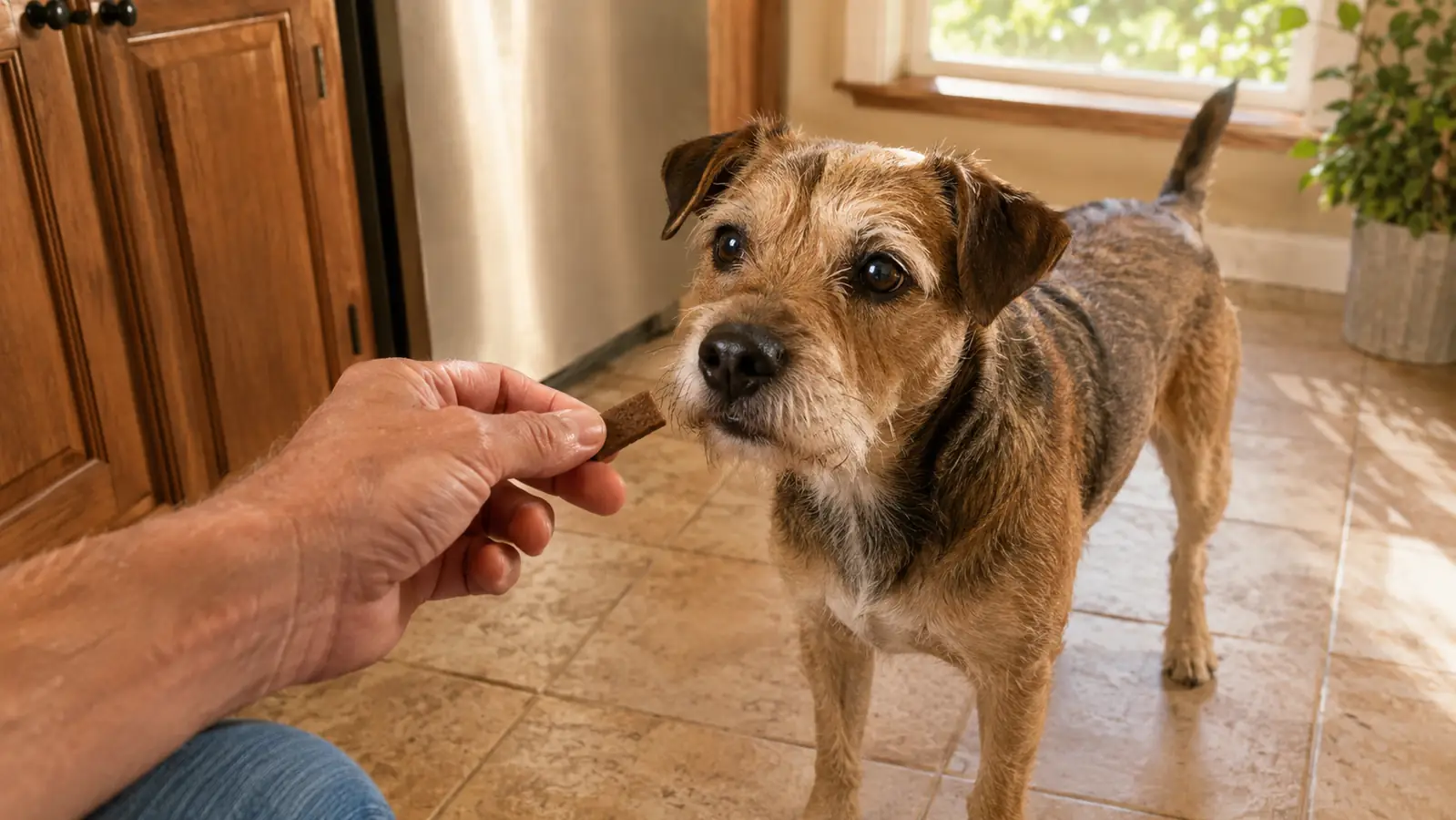
The chews are chicken flavored and soft, closer to a jerky treat texture than a hard biscuit. Millie took to the flavor fast, usually snatching it out of my hand before I'd even fully opened my fingers. My sister's dog, a much pickier eater who was visiting for a week in March, sniffed it twice and walked away both times, so I'll flag that palatability seems to vary more than the ingredient list would suggest. I ended up crumbling one into her regular food that week just to get it in her, and even then she picked around it.
Six Months In: Storms, Car Rides, and the Vet Waiting Room
The clearest before-and-after came from car rides, because those are short and repeatable. In January, before I started the VetriScience chews, Millie would whine from the driveway to the parking lot for any trip over ten minutes, and she'd arrive at the vet already shaking. By April, on a chew given about twenty minutes before we left, she settled into the back seat within the first few blocks most trips. Not every trip. I'd say roughly three out of four car rides went noticeably better, and the fourth was still rough, usually when the trip itself involved something scarier than the drive, like a nail trim.
Storms were slower to show a difference and never got as clean a result. Florida summer storms are loud, frequent, and sometimes stack two or three in a single afternoon, so I was giving Millie a chew, riding out the first storm, and then watching a second one roll in an hour later with nothing left in her system. On single, isolated storms, the improvement by month two was real: less pacing, less digging at the door, more willingness to lie down near me instead of hiding behind the recliner. On stacked, back-to-back storm days, she still had a hard time, and I don't think any chew was going to fully solve that.
The vet waiting room is the one place I never saw much change, and I think that's honest to report. Waiting rooms come with other dogs, unfamiliar smells, and a scale she has to stand on, and a calming chew didn't touch any of that. Millie still trembled in the lobby in July the same way she did in January. Once we were in the exam room with the door shut, though, she calmed down faster than she used to, which I chalk up more to the chew's effect on her baseline stress level than to anything specific about the room.
What I Tried Before This, and Why I Kept Going
The plug-in diffuser was my first attempt, months before I ever looked at VetriScience. It's a pheromone product that plugs into an outlet and is supposed to mimic a calming scent dogs produce naturally. I ran it for six weeks in the living room and genuinely could not tell you if it did anything. Millie's storm behavior in week six looked identical to week one.
Next was the anxiety wrap, a snug vest that applies gentle pressure, similar in concept to swaddling. It helped a little during car rides, honestly more than the diffuser did, but it did nothing for storms, and getting an already-anxious dog into a tight-fitting vest before a stressful event turned into its own small ordeal some days, because by the time thunder was audible she didn't want to stand still for anything.
I mention both because I don't think VetriScience chews are magic, I think they're one layer that worked better than the layers I'd tried before, and they're easier to use consistently than a wrap you have to physically put on a squirming dog. For a while I actually ran the wrap and the chew together during storms, and that combination was the closest I got to Millie acting like her normal self through a full-blown thunderstorm.

Comparing Notes With Gus and Pearl
I mentioned Gus a minute ago, so I want to be clear about why he's not part of this review. Gus is my twelve-year-old Lab mix, and his issue is mild age-related hip stiffness that our vet has already looked at, not anxiety. He's the calmest dog I own during a storm, he just sighs and goes back to sleep on his bed. So when I say the VetriScience chews didn't change anything about Gus, that's because I never gave them to him. This is a calming product, not a joint product, and I'd rather tell you plainly it isn't what he needed than let you assume it's a do-everything supplement.
Pearl, my ten-year-old indoor cat, doesn't get these either. They're formulated and dosed for dogs, and Pearl's version of a bad storm day is hiding under the bed for an hour and coming out fine on her own, so there's never been a reason to reach for anything. I bring this up only because readers moving between the reviews on this site sometimes assume every product in my house gets used on every animal in my house, and that's just not true here. This one is Millie's, specifically, and specifically for the handful of triggers I already know are coming.
What I'd Do Differently
If I were starting over, I'd give the first bag a full month before deciding anything, storm or no storm, instead of getting discouraged in week two the way I almost did. I'd also keep the log from day one instead of starting it halfway through, because looking back at real notes instead of my memory of a stressful afternoon changed how I read the results.
I'd also stop expecting the chew to do the job a wrap or a quiet room does. On the worst storm days, the combination of the chew plus keeping Millie in the smallest, most enclosed room in the house, our bathroom, worked better than the chew alone ever did. That's not a knock on VetriScience, it's just a more honest picture of what one supplement can reasonably be expected to carry by itself.
By month two, roughly three out of four car rides went noticeably better. The fourth was usually the one where the destination was scarier than the drive.
What I Liked
- Noticeable softening of car-ride anxiety within about three weeks of regular use
- Chicken flavor is soft and easy for most dogs to take without a fight
- No grogginess or sedated behavior afterward, Millie is playful within the hour
- Ingredient list is simple and doesn't read like a mystery blend
- Easy to use situationally instead of committing to a daily supplement
Where It Falls Short
- Barely touched vet waiting room anxiety, which has more to do with the environment than her stress hormones
- Back-to-back storms in the same afternoon overwhelmed whatever benefit the first chew gave
- A picky-eater dog in my house refused the flavor twice
- Took two to three weeks before I saw a real, repeatable difference, not an instant fix
- This is not a substitute for a vet's input if the anxiety is severe or worsening
Who This Is For
This is for the dog whose anxiety shows up around specific, somewhat predictable triggers: storms, car rides, a visitor staying over, a groomer appointment on the calendar. If you can see the trigger coming with enough lead time to give a chew thirty to forty-five minutes ahead, VetriScience Calm & Confident has a real shot at taking the edge off. It's also a reasonable first thing to try if your dog's stress is moderate and you haven't already been through a vet workup, as long as you're watching for whether it's actually helping rather than just hoping it is. I'd also say it's worth trying if your dog's stress shows up mostly around a handful of known events rather than as a constant, low hum of nervousness, because that's exactly the pattern where a chew given ahead of time has room to do its job.
Who Should Skip It
If your dog's anxiety is severe, constant, or involves anything close to self-injury, destructive chewing through doors, or panic that doesn't ease once the trigger is gone, please talk to your vet before relying on an over-the-counter chew. This kind of product is built for everyday stress, not for a dog who needs a real behavioral or medical plan. I'd also skip it if you've got a genuinely picky eater and no backup plan, because a calming chew that sits untouched on the floor isn't calming anything. And if you're hoping for something that works the very first time you use it, temper that expectation now, because for us the real payoff didn't show up until closer to the three-week mark.
Ready to try it before your next storm or car ride?
Check today's price and availability for VetriScience Calm & Confident on Amazon.
Amazon Check Today's Price on Amazon →