

My terrier mix Millie is nine years old, and until last spring I never once thought about her skin. She is the healthy one in this house, no joint trouble, no vet visits beyond her yearly checkup, the dog everyone calls the tough little cookie next to her much slower housemate Gus. Then Ocala had one of those brutal dry stretches in February, heat running constantly, humidity dropping, and I noticed a bald patch starting behind her left ear and flakes of dry skin left on the dark couch cushion every time she jumped up.
I tried an oatmeal shampoo first. It helped for about four days and then the itching came right back, worse if anything, because now her skin was dry from the wash on top of dry from the air. A friend who has bred terriers for years told me to stop treating the outside of the problem and start feeding the inside of it. She had been putting Zesty Paws Salmon Oil in her dogs' food for exactly this kind of dry-air itch. I was skeptical. I had already burned money on a lavender spray that did nothing and a skin and coat treat bag that Millie ate like candy and changed nothing measurable. Salmon oil is different because it is not a surface fix, it is an omega-3 you feed daily and give real time to work through the skin from underneath. Here is exactly how I used it with Millie, step by step, including how long it actually took before I saw a difference I could point to, and what I did alongside it that made the difference stick.
Millie's Scratching Slowed Down Inside Three Weeks
Zesty Paws Salmon Oil is what I pump onto her food every single morning now, dog and cat both use the same bottle in my house. Check today's price and current stock on Amazon before you start your own trial.
Amazon Check Today's Price on Amazon →Step 1: Rule out the other causes before you assume it is dry skin
Itchy, flaky skin has more than one cause, and salmon oil only helps with one of them. Before I started anything, I called Millie's vet and described the bald patch and the flaking. He checked her for fleas, ear mites, and a skin infection, none of which showed up, and confirmed what I suspected: seasonally dry skin made worse by the indoor heat we were running around the clock. If your dog or cat is losing hair in patches, has red or inflamed skin, has sores, or the itching came on suddenly and severely, ask your vet before you try any supplement. A daily fish oil is not a substitute for diagnosing something that needs actual treatment, and starting a new supplement on an animal who is pregnant, nursing, very young, or on other medication should also go through your vet first.
Once fleas, mites, and infection were off the table, what was left was plain dry skin. That is the specific situation an omega-3 like salmon oil is meant to support, alongside the coat, not instead of a real diagnosis.
I also asked specifically about food allergies, since that is another common cause of chronic itching that a fish oil will not fix on its own. Millie had been on the same kibble for two years without issue, so her vet ruled that out as the likely trigger and pointed back to the dry indoor air as the more probable cause given the timing. If your pet's itching started right after a food switch, that is a different problem to solve first.
Step 2: Dose by your pet's actual weight, not by guesswork
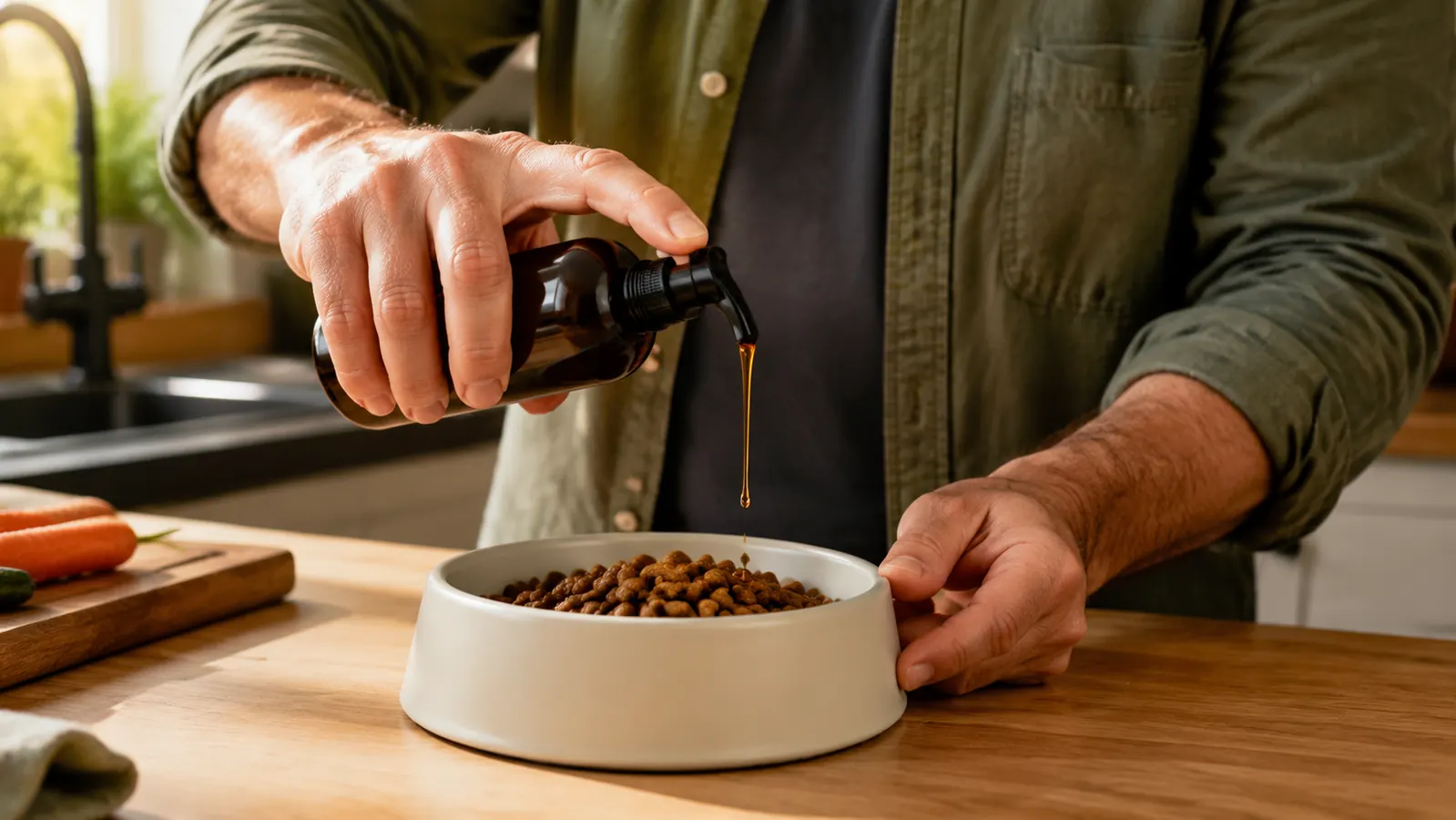
Zesty Paws Salmon Oil comes in a pump bottle, and the label gives a dosing guideline by weight, from small dogs and cats up through large breeds. Millie is 24 pounds, so I started her at the amount listed for her weight range rather than eyeballing it or copying whatever amount a friend gives her much bigger dog. Too little and you are basically feeding flavored oil with no real effect. Too much, too fast, and you can upset a sensitive stomach, especially in a cat like my ten-year-old Pearl, who gets a noticeably smaller pump than Millie or my senior dog Gus does.
I pump it directly onto the morning meal and mix it into the kibble so it coats every piece rather than sitting in a puddle at the bottom of the bowl. If your dog or cat is a slow eater or picky about textures, start with a half dose for the first two or three days so their stomach adjusts, then move to the full amount the label lists for their weight.
I also weigh Millie again every few months rather than assuming her weight has stayed fixed since the last vet visit, because the correct amount shifts as her weight does. A senior dog like Gus who has put on a pound or two over winter needs the dose recalculated too, not left on whatever number I first wrote down a year ago. And I keep the bottle in the refrigerator once it is opened, since fish oil goes rancid faster at room temperature and a rancid oil will not do her skin any favors.
Step 3: Commit to daily use for a full four to six weeks before judging it
This is the step people skip, and it is the reason so many supplements get labeled useless when the real problem was that nobody gave them enough time. Skin cells turn over on a cycle that takes weeks, not days, so a topical spray can calm surface itching in an afternoon but an ingested omega-3 has to work its way into new skin and coat growth before you see anything. I put a recurring reminder on my phone for Millie's morning feeding specifically because a missed day here and there stretches the timeline out even further. Consistency matters more than the exact time of day.
I did not see anything different in week one. By the end of week two, the flaking on the couch cushion had noticeably dropped off, though the itching was still there. It was week three when I actually caught myself thinking she is not scratching at that ear constantly anymore, and by week five the bald patch behind her ear had visibly started filling back in with new fur.
Week six is when I felt confident calling it a real change and not a lucky stretch of milder weather. That timeline lines up with what her vet had told me to expect, roughly a month to six weeks before omega-3 supplementation shows up visibly in the coat and skin, since the improvement rides along with normal cell turnover rather than acting like a spray you can see work in minutes.

Step 4: Track three specific things weekly instead of relying on a general impression
Vague impressions lie to you, especially with your own pet, because you want it to be working. I kept it simple and tracked three things on a sticky note on the fridge, once a week, same day each time: how many times I actually saw her scratch at that ear in a ten-minute window after dinner, whether there were visible flakes on the dark couch cushion, and whether the coat over her back looked flat and dull or had some shine to it under the kitchen light.
That log is what let me tell the difference between working and just wishful thinking. Week one and two looked almost identical on paper, both logged around a dozen scratches and visible flaking. Week three showed the scratching count drop from roughly a dozen instances to four. By week five, flakes on the couch were gone entirely and the coat had a shine I could see without touching her. If you skip the tracking, you will likely either give up too early because nothing feels different day to day, or convince yourself it is working when nothing has actually changed.
A written log also matters if you ever need to show your vet what actually happened, week by week, instead of trying to reconstruct it from memory two months later. I still have that sticky note stuck to the inside of a kitchen cabinet, and I glance at it now if her scratching ever picks back up so I can tell right away whether it is a new stretch of dry weather or something that needs a second look.
Step 5: Adjust and recheck with your vet if you see no movement by week six
If you have been consistent with the correct dose for six full weeks and your tracking notes show no real change, that is useful information, not a failure on your part. It usually means the itching has a cause salmon oil was never going to touch, an allergy, a food sensitivity, or something dermatological that needs an actual exam. Go back to your vet with your notes in hand rather than just stopping and trying something else at random. Having a real record of what you tried, for how long, and what changed or didn't makes that conversation faster and more useful than describing it from memory.
Do not stack a second fish oil product on top of the first one just because progress feels slow at week three. More omega-3 is not automatically better, and doubling up on two different products makes it impossible to know which dose actually worked if things do improve. Stick with one product at the labeled amount for your pet's weight through the full trial window before deciding whether to adjust anything.
What Else Helps
Salmon oil did the heavy lifting for Millie, but I did not treat it as the only variable. I switched her water bowl to filtered water since our well water runs hard and can dry out skin on its own. I brush her coat two or three times a week now instead of only at bath time, which spreads natural oils and lets me actually check her skin for new problems early. And since dry indoor heat was part of what started this in the first place, I run a small humidifier in the room where she sleeps during the driest stretches of winter.
I also looked at the food itself. Millie's kibble lists a named fat source, not a vague generic one, and I have kept it that way since a low quality fat blend can work against whatever the salmon oil is trying to do. I bathe her less often now too, once every few weeks instead of every week, because frequent washing strips natural oils out of the coat faster than the salmon oil can replace them. None of these steps replace the oil, but they stack with it, and together they got her further than the salmon oil would have gotten her alone. Gus gets the same pump in his food every morning now too, mostly because his coat had started looking a little duller over the winter, even without the itching Millie had.
By week five the bald patch behind her ear had visibly started filling back in with new fur, and the flakes on the couch cushion were just gone.
Give the Six-Week Routine a Real Shot
Zesty Paws Salmon Oil is the exact pump bottle I used on Millie, dosed by weight and given every single morning without skipping. See today's price and availability on Amazon before you start your own tracking log.
Amazon Check Today's Price on Amazon →