
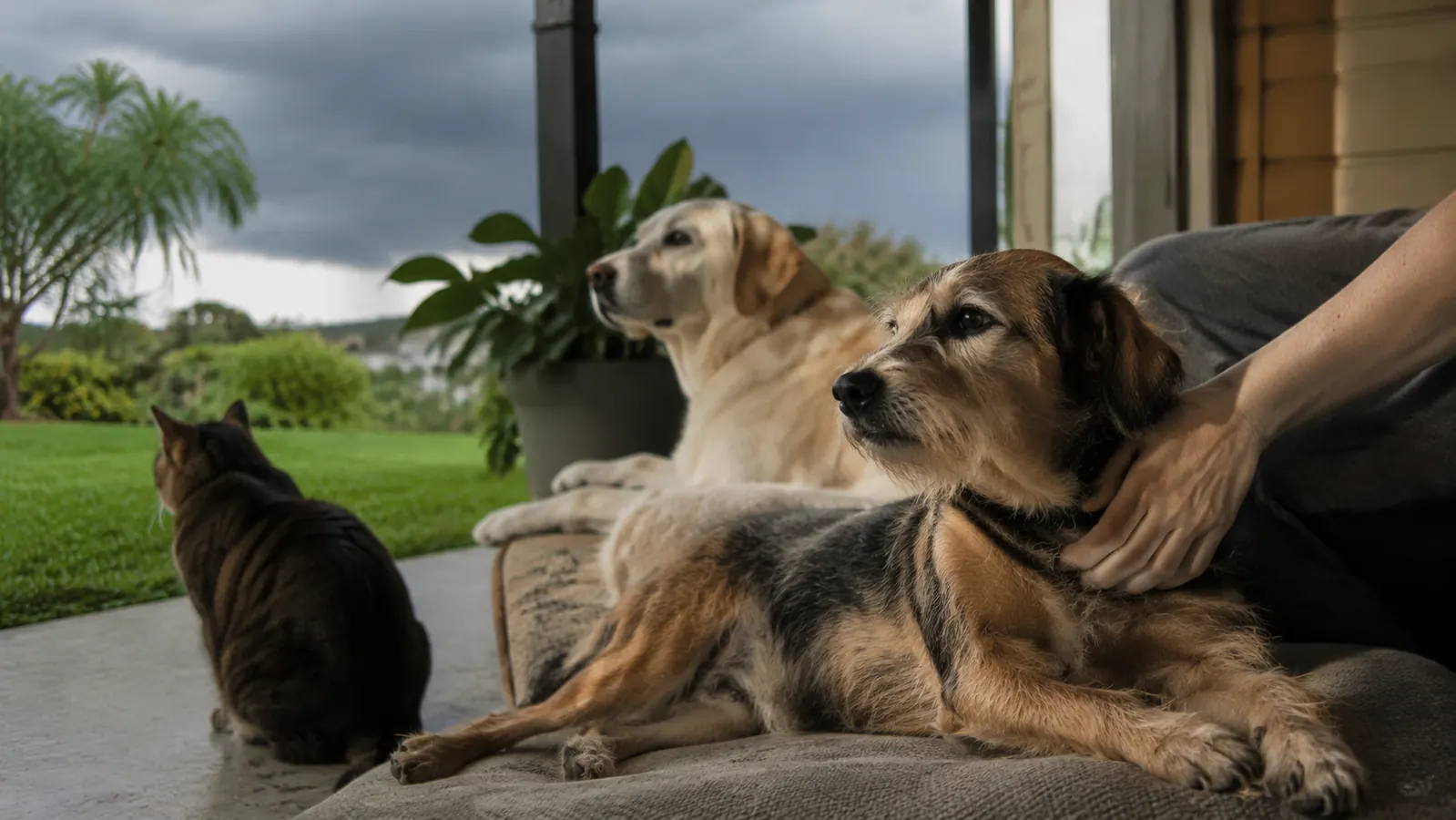
The first bad storm of the season used to start the same way in my house. The sky over Ocala would go that strange greenish gray around four in the afternoon, and by four fifteen Millie, my nine-year-old terrier mix, would already be pacing the hallway, panting hard, ears pinned back, trying to wedge herself into the coat closet before the first rumble even hit. Gus, my twelve-year-old Lab mix, handles storms differently. He just walks the same twelve steps of kitchen tile over and over until his hips ache from the turning, which is its own kind of miserable to watch. I tried waiting it out. I tried a compression wrap that Millie chewed a hole through in a week. I tried sitting on the closet floor holding a treat she wouldn't even look at. None of it touched what was actually happening in her body once the barometric pressure started dropping.
What finally moved the needle wasn't one dramatic fix. It was a routine built around VetriScience Calm & Confident chews, given consistently and timed to her actual triggers instead of my hope that this particular storm would blow through fast. Below is exactly how I built that routine, step by step, the same way I'd walk a friend through it over coffee on my porch.
Before the Next Storm Rolls In
If you already know your dog's trigger season is coming, this is the chew I keep stocked in the pantry year-round. Check today's price and have it on hand before you need it.
Amazon Check Today's Price on Amazon →Step 1: Figure Out What's Actually Triggering the Stress
Before I gave Millie a single chew, I spent about a week just watching her and writing things down. Not a formal log, just notes on my phone: what time she started panting, what happened right before, how long it lasted. Storms were the obvious one in Florida, but I also noticed she got the same wide-eyed, drooling look about ten minutes into any car ride longer than the vet's office, and again the night before I packed a suitcase, which took me embarrassingly long to connect.
Gus doesn't show stress the same way Millie does, and that matters, because it means the plan I built for her wasn't automatically the right plan for him. He gets restless and paces rather than hides, and his triggers are narrower, mostly loud fireworks and unfamiliar dogs at the vet's waiting room. If your dog's stress shows up differently than mine, don't assume the schedule or dosage that works for one animal transfers cleanly to another, even in the same house.
I also started paying attention to anticipatory anxiety, the stress that shows up before the actual trigger. Millie would start pacing at the sight of the suitcase, not the car ride itself, and she'd get restless the moment I picked up the leash for a vet visit, well before we ever left the driveway. Once I noticed that pattern, I stopped treating the trigger as a single moment and started treating it as a window that opens earlier than you'd think, sometimes twenty or thirty minutes before the thing you'd assume actually causes the stress.
Write down the actual pattern before you start. A chew given at random, disconnected from the thing that's actually setting your dog off, is a lot less useful than one timed to a trigger you've already identified and can predict.
Step 2: Introduce the Chew Before You Need It
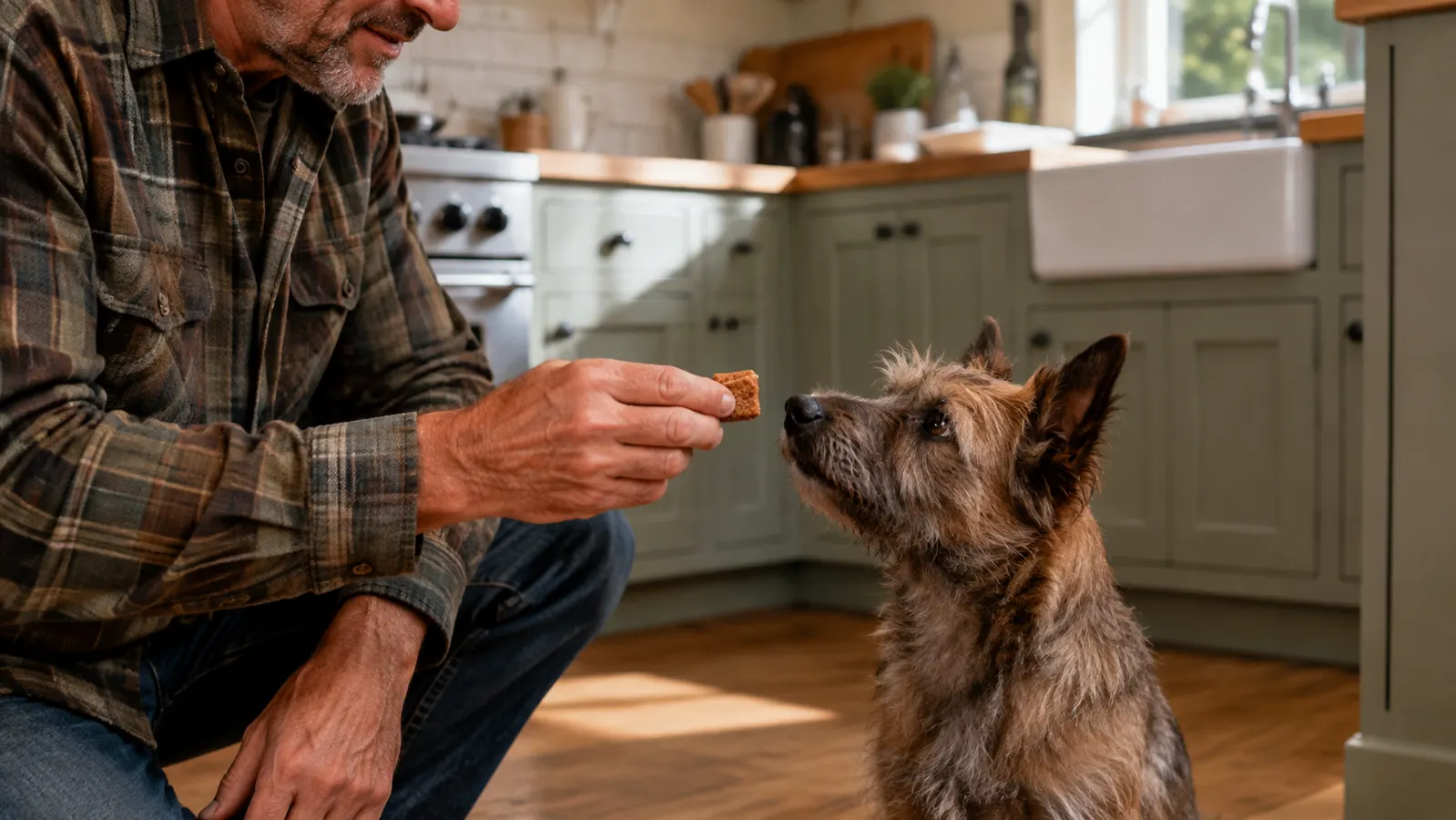
The single biggest mistake I made the first time around was waiting for the first big storm of the season to try VetriScience Calm & Confident chews for the first time. That is the worst possible moment to introduce anything new. Millie was already stressed, her stomach was already unsettled, and I had no idea whether the chew itself would sit well with her or whether the flavor would be something she'd actually take from my hand under normal circumstances.
Instead, on the second attempt, I started giving her a chew on a completely calm Tuesday afternoon, with food, the same way I'd introduce any new supplement. I watched her stool and appetite over the following few days the way I would with anything new in her diet. Only once I knew she tolerated it fine on an ordinary day did I trust it to actually do its job on a hard one.
The bag lists dosing by weight on the label, and I stuck to that exactly rather than guessing. Millie is on the smaller end of the range and Gus, being a bigger dog, would need a different amount if I ever used it for his fireworks anxiety. If your dog is on any other medication, pregnant, nursing, or very young, or if you're not sure how a calming chew might interact with something else going on with them, that's a conversation for your vet before you start, not a guess you make on your own.
One small logistics note that made the routine easier to keep up: I keep the bag sealed and in the pantry rather than tossed in a drawer, and I set a standing reminder on my phone to check the count around the middle of the bag so I'm never caught reaching for it the afternoon a storm is already rolling in. Running out mid-trigger defeats the whole point of building a routine in the first place.
Step 3: Time the Dose to the Trigger, Not the Clock
This is where the weather app on my phone became part of Millie's care routine, which sounds silly until you've lived through enough Florida summer afternoons to know the storms roll in almost like clockwork. Once I knew VetriScience's chews took roughly thirty to forty five minutes to seem to take effect for her, I stopped giving them the moment thunder started and started giving them the moment I saw the radar building west of town. Same idea for car rides: a chew about half an hour before we backed out of the driveway, not one tossed to her while she was already whining in the back seat.
For a predictable, recurring trigger like an anxious dog's daily separation stress, some owners give a chew at roughly the same time each morning instead of chasing individual events. I didn't need that for Millie since her stress is event-based, but if your dog's anxiety is more of a constant hum than a spike, ask your vet whether a steady daily routine makes more sense than an as-needed one for your particular dog.
I've also started applying the same lead time to grooming appointments and the annual vet exam, both of which used to catch me off guard because I'd forget they counted as a trigger at all until Millie was already shaking in the waiting room. Now the chew goes in about the time I'm loading her into the car, and the whole appointment runs smoother from the front door onward.

Step 4: Pair the Chew With a Physical Calm-Down Routine
The chew was never the whole plan by itself, and I don't think it would have worked as well as it did if it had been. I built a physical routine around it: closing the blinds so the lightning flashes were less visible, turning on the box fan in the hallway to flatten out the thunder a little, and moving her bed away from the exterior wall and into the bathroom, which has always felt like her safest room in the house.
I also started taking her on a longer walk earlier in the day whenever the forecast showed storms coming, so she'd already have some of the restless energy burned off before the trigger hit. A dog who's already tired handles a stressful hour differently than one who's wound up and full of pent-up energy on top of being scared.
One thing I had to unlearn was over-coddling the panic itself. Comfort her, absolutely, but I stopped the high, worried baby-talk voice I used to use, because I noticed it seemed to confirm to her that something really was wrong. A calm, low, boring voice while she settled into her spot did more for her than any amount of frantic reassurance ever did.
I also tried an open crate with the door left off versus a closed room, and for Millie the open bathroom with the door cracked worked better than the crate ever did. Gus, being older and less inclined to hide anywhere small, does better just staying near me on the kitchen tile. Try a couple of setups over a few uneventful weeks so you already know your dog's preference before a real trigger shows up.
Step 5: Track What Changes, and What Doesn't, Over Two Weeks
I kept the same rough notes I'd started with in step one and just kept adding to them for about two weeks. Not every storm went perfectly. There was one night in late June with fireworks and thunder stacked on top of each other that overwhelmed whatever the chew was doing, and Millie still ended up in the closet. That's useful information too. It told me the chew was helping with garden-variety triggers but wasn't going to be a match for the worst nights, and I adjusted my expectations accordingly instead of assuming something had failed.
By the end of two weeks, the pattern was clear enough that I trusted it. Most storms, most car rides, Millie was noticeably calmer, staying out in the open rooms of the house instead of disappearing. If two to three weeks go by with genuinely no change at all in your dog's behavior, or if the anxiety seems to be getting worse rather than better, that's the point to stop guessing and call your vet, especially if you're also seeing changes in appetite, aggression, or any sudden shift in behavior that feels out of character.
Looking back, there are two things I'd do differently if I were starting over. I'd have started the trial run earlier in the spring instead of waiting until the first storm caught me unprepared, and I'd have kept my notes on paper by the door instead of scattered across notes apps on my phone, because the fastest way to lose a useful pattern is to lose track of where you wrote it down.
What Else Helps
A few things outside the chew itself made a real difference for us. A predictable daily walk schedule seemed to lower Millie's baseline stress overall, not just on trigger days. I also stopped rearranging furniture or making sudden changes to her environment during storm season specifically, since a dog already primed to be anxious doesn't need extra novelty stacked on top. And having her safe spot, the bathroom with her bed in it, set up and ready before the trigger hits rather than scrambling to create one mid-panic made the whole routine run smoother.
Consistency mattered more than I expected. Skipping the chew for a week because things felt calm, then reaching for it again the moment a big trigger showed up, never worked as well as keeping the routine going steadily so her body wasn't adjusting to something brand new every time. I also keep her meals and walk times fairly steady day to day, since an already unpredictable schedule seems to make the trigger days harder on her than they need to be.
If your dog's anxiety is severe, sudden in onset, or tied to something like separation that's disrupting your household daily, a calming chew is a reasonable piece of a plan, but it isn't a substitute for a conversation with your vet about what's actually going on. Ask your vet before combining a calming chew with any other medication, and always ask before giving anything to a puppy, a pregnant or nursing dog, or a dog with an existing health condition.
Millie went from hiding in the coat closet by four fifteen to lying on the kitchen tile through a full hour of thunder. Still restless, still watching the window, but she stayed in the room.
Build Your Own Storm-Season Routine
This is the chew I keep in the pantry from June through September. Have it on hand before the next trigger hits instead of scrambling for it mid-storm.
Amazon Check Today's Price on Amazon →